


Your customers are already on WhatsApp. Your business probably isn't.
South Africa is a WhatsApp-first country. More than 28 million South Africans use WhatsApp every month — more than use Facebook, Instagram, or email combined. Yet most SA businesses still expect customers to fill in a contact form, wait for an email reply, and book a call through a Calendly link. The friction is enormous, and it costs sales every single day.
This post explains why South Africans buy on WhatsApp, what the data actually shows, and the practical steps a business can take to start selling there — without ending up with one employee drowning in chats on their personal phone.
Why WhatsApp wins in South Africa
Three things make WhatsApp the dominant commercial channel in SA — and they don't apply the same way in the US or Europe.
1. Data costs make email and websites expensive to use
South Africans pay some of the highest mobile data prices in the world relative to income. Loading a 4MB website with hero videos and three fonts costs real money. A WhatsApp message costs almost nothing — the protocol is lightweight, and most users have a "WhatsApp-only" data bundle from their network. Your website might be invisible to a prospect with R10 of airtime left. Your WhatsApp message is not.
2. Trust lives in the chat thread
South Africans treat WhatsApp the way Americans treat SMS — it's where real people talk to real people. A business that replies on WhatsApp feels human. A business that only replies via "info@" feels like a call centre. For service-led purchases (medical, legal, trades, real estate, education) the trust gap is the entire sale.
3. The phone is the computer
Over 70% of internet traffic in SA is mobile. For a large share of the country, the phone is the only computer. WhatsApp is the default app for everything: orders, photos of damaged products, voice notes describing problems, location pins, proof of payment. Asking those customers to "fill in the contact form on our website" is asking them to switch tools, lose context, and remember to come back.
Real example: a Garden Route plumber switched his "Contact Us" form to a WhatsApp click-to-chat link. Enquiries tripled in the first month — not because more people found him, but because the people who already found him stopped giving up at the form.
What the numbers say
- WhatsApp open rates sit around 90%+ within 15 minutes, compared to roughly 20% for email — and most email opens take hours or days.
- Reply rates on WhatsApp are 5–10x higher than email for the same audience.
- SA users check WhatsApp dozens of times per day. They check email far less, and many small-business customers don't use email at all.
- WhatsApp Business has hundreds of millions of users globally — and is free to install. The paid WhatsApp Business Platform (API) is what enables automation, multiple agents, and CRM integration.
You don't need to win an argument about the data. Look at how you yourself buy from local SA businesses. Almost certainly: WhatsApp.
What most SA businesses get wrong on WhatsApp
Switching to WhatsApp is not a magic upgrade. Most businesses that try it badly make the same five mistakes.
1. Running the business off one person's personal phone
One employee — usually the owner or a receptionist — becomes the bottleneck for every enquiry. When they're sick, on leave, or asleep, the business stops responding. When they leave, the customer relationships leave with them.
2. Replying only during office hours
WhatsApp is a 24/7 channel. South African customers send enquiries at 22:00 after the kids are in bed, or at 06:00 before work. A business that takes 14 hours to reply has already lost most of those leads to the competitor who replied at 22:03.

3. No qualification, no routing
Every enquiry — "what are your prices?", "do you deliver to Knysna?", "I need a quote for 200 units" — gets the same generic response. High-value leads sit in the same queue as time-wasters and existing customers asking about invoices.
4. No record of the conversation
The whole sales pipeline lives in one phone's chat list. There is no CRM, no follow-up reminders, no handover when a lead converts. If the phone is lost or stolen, the business loses its history.
5. Treating WhatsApp like email
Long paragraphs, formal greetings, attached PDFs. WhatsApp rewards short, conversational, fast replies. Voice notes. Photos. Concise prices. The businesses that win on WhatsApp talk like a human — not a marketing department.
How to actually sell on WhatsApp — the system that works
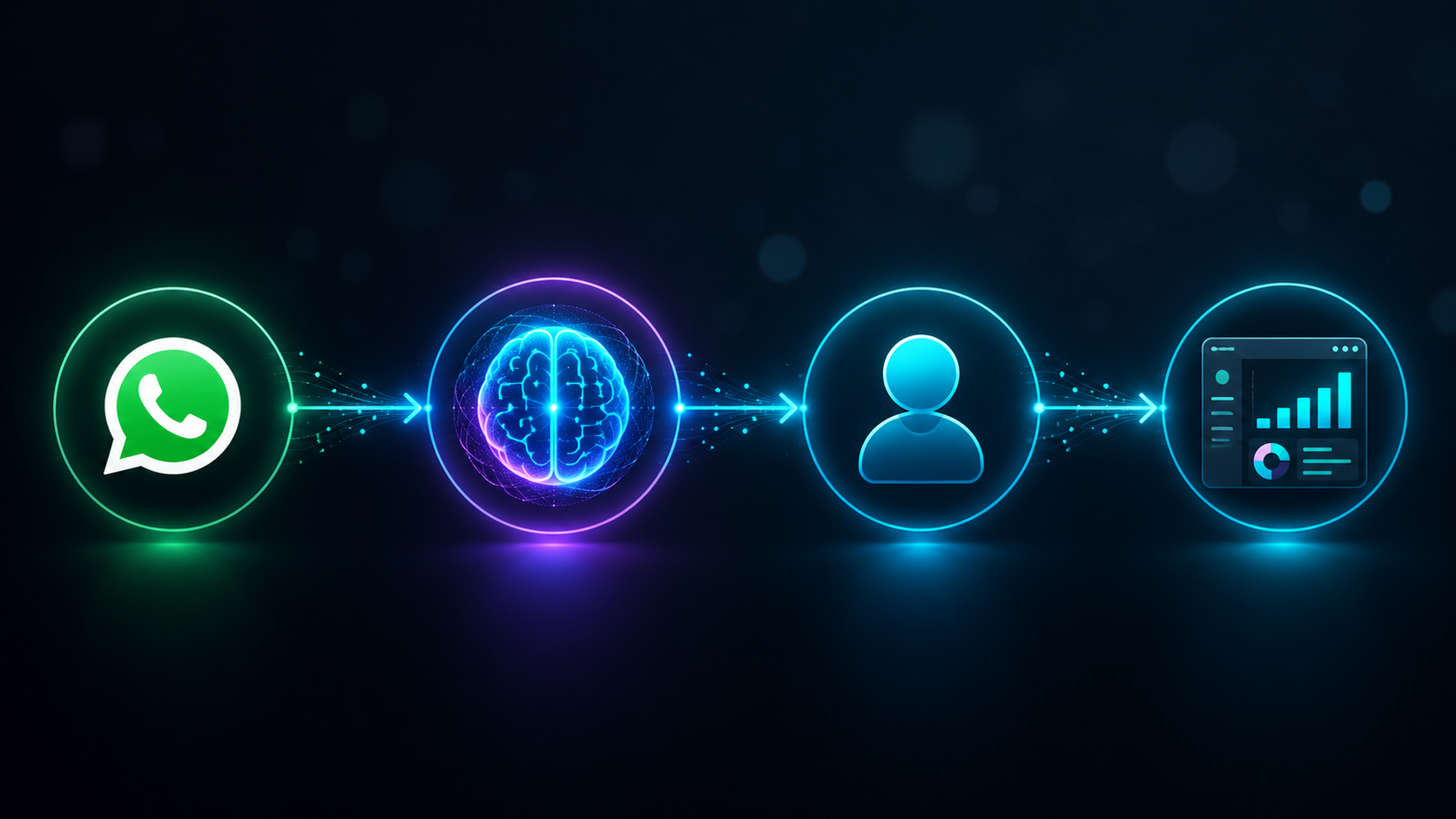
A WhatsApp sales system that scales past one person has four parts.
1. A WhatsApp Business Platform (API) number, not a personal one
The free WhatsApp Business app is fine for a one-person shop. As soon as more than one person needs to reply, you need the WhatsApp Business Platform (also called the API). It allows multiple agents on the same number, integrates with a CRM, and unlocks automation — without breaking WhatsApp's terms of service.
2. An AI agent on the front line
An AI chatbot answers the first message — at any hour — and handles the 80% of enquiries that are pricing, hours, location, "do you do X?", and basic FAQs. It qualifies leads using a short, friendly conversation. It books appointments straight into the calendar. It collects the information a human would need before quoting.
3. Clean handover to a human when it matters
When a real prospect is ready to talk specifics, the AI hands the conversation to a human with full context — name, what they want, what's been discussed. The human starts from a position of knowledge, not "hi, how can I help?".
4. A CRM that actually remembers
Every conversation, every booking, every follow-up lives in a system. When the customer messages again three months later, the business already knows who they are, what they bought, and what they wanted last time. This is the difference between a small business and a professional one.
Common questions
Won't customers find a chatbot annoying?
Only if it's a bad chatbot. The current generation of AI agents — including the one EzeMind builds — converse naturally, can voice-note replies, and hand to a human the moment the conversation needs it. The annoying part of "press 1 for accounts, press 2 for sales" is exactly what AI removes.
Can my existing phone number be used?
An existing landline or mobile number can usually be migrated to the WhatsApp Business Platform — but only if the number isn't already attached to a personal WhatsApp account. Most businesses move to a dedicated number to keep things clean.
Is this POPIA-compliant?
Yes — when set up correctly. WhatsApp messages are personal data under POPIA, so consent, data retention, and access rights all need to be handled properly. A proper WhatsApp CRM build (not a Google-Sheets-and-prayer setup) handles this for you.
What does it cost?
WhatsApp Business Platform pricing is per-conversation (a fraction of a Rand for most), plus the CRM and AI agent build. For most SA SMEs, the entire system pays for itself within the first month of additional booked appointments.
Where to start
If you're already replying to customers on WhatsApp from a personal phone, you have a head start — you've proven there's demand. The next step is to put a system around it so the business doesn't depend on one person's thumbs.
EzeMind builds WhatsApp CRMs end-to-end: number setup, AI agent training on your business, calendar integration, CRM, human handover, POPIA compliance. Fixed pricing, 1–4 week delivery for most builds.