


ChatGPT in a browser tab is a power tool lying on the workbench. A strategy is the thing that picks it up, plugs it into your business, and uses it the same way every day — whether you're thinking about it or not.
"We'll just use ChatGPT" is the most common answer South African business owners give when you ask about their AI plan — and it isn't a plan at all. It's the same as saying your logistics strategy is "we've got a bakkie." The bakkie is real and genuinely useful. But owning one isn't a delivery business, and having ChatGPT open in a tab isn't an AI strategy. The gap between the two is exactly where the money is.
First, the honest part: this is not an anti-ChatGPT post. The models behind ChatGPT, Claude and the rest are genuinely extraordinary, and if your team uses them every day, good — keep going. The argument here is narrower and more useful than "tool good" or "tool bad." It's about the difference between a person using a chatbot and a business running on an AI system — because almost everyone confuses the first for the second, then wonders why the AI "didn't really change anything."
What "just use ChatGPT" actually gets you
Used as a personal tool, ChatGPT is a real productivity win — and that's worth saying plainly. It drafts the email, rewrites the quote, summarises the contract, fixes the spreadsheet formula and explains the thing you were too embarrassed to ask about. For one person at a keyboard, that's hours back every week.
But notice the shape of all of that: it's you, in a tab, copy-pasting, one task at a time. The intelligence is rented by the question and it evaporates the moment you close the window. That's the ceiling. It's a brilliant assistant for the person holding the keyboard — and it does nothing for the business when that person is asleep, on site, on leave or simply busy. A strategy is what survives the window being closed.
The five things a browser tab full of ChatGPT can't do
Strip away the hype and the gap between "using ChatGPT" and "having an AI strategy" comes down to five things the tab simply can't do on its own. None of them are about how clever the model is. They're about everything around the model.
1. It doesn't know your business
Public ChatGPT doesn't know your price list, your stock, your lead times, your past customers or your policies. Every conversation starts from zero, so every answer is generic until you spend five minutes pasting context back in. An AI system is connected to your actual data — so it already knows a 200L geyser install starts at R6,500, that you don't service south of Mossel Bay, and that this customer bought from you in March.
2. It advises — it doesn't do the work
Ask ChatGPT to handle a customer enquiry and it writes you a lovely reply. It won't send it. It won't book the slot, update the CRM, raise the invoice or follow up on day three. It hands you homework. The whole point of an AI agent is that it takes actions inside your tools — it sends, books, logs and chases — instead of producing text you still have to act on yourself.
3. It only works when you're driving it
A browser tab waits for you. It has no idea a WhatsApp enquiry just landed at 21:30, that a booking needs confirming, or that a quote has gone quiet for five days. A real strategy runs on triggers, not on you remembering — it reacts to events 24/7, which in a country where business happens on WhatsApp after hours and right through loadshedding is most of the game. We unpack the channel itself in why South Africans buy on WhatsApp.
4. It forgets everything the moment you close it
Consumer ChatGPT keeps no durable memory of your operations. It can't tell you which enquiries converted, what customers keep asking, or where your leads leak — because it never kept the data. A system captures every interaction, so it gets better at your business over time and hands you the reporting as a side effect. Dabbling compounds nothing; a system compounds every day.
5. It has no guardrails, no brand voice, and no owner
In a tab, the answer is whatever the model felt like saying, in whatever tone, with no checks. A business needs the opposite: approved answers only, your voice, escalation rules, and a clear line on what it must never do — invent a price, promise a date, or leak a customer's details. That governance layer, not the model, is what makes AI safe to put in front of customers. More on the compliance side in POPIA + AI tools.
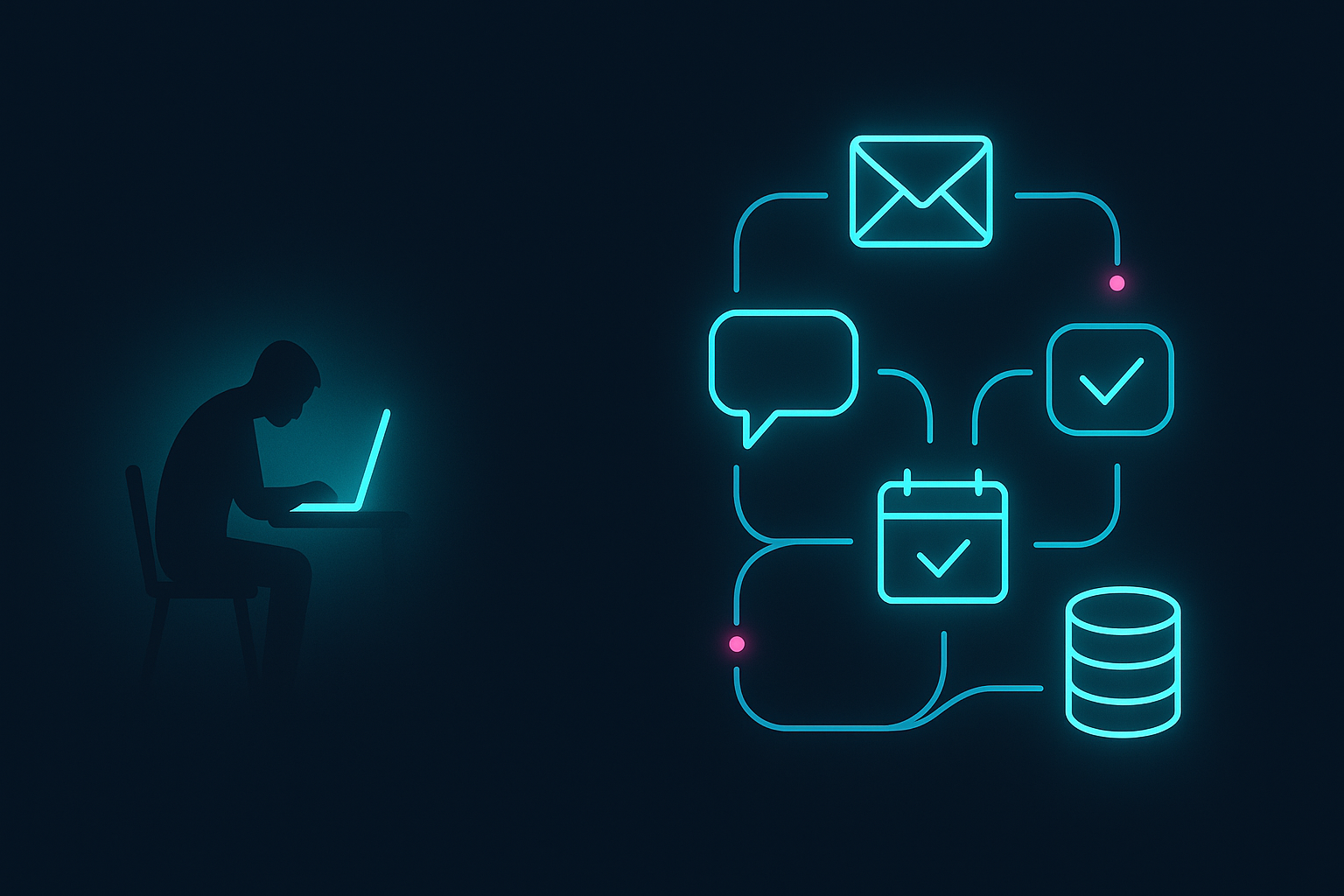
Tool versus system — what an AI strategy actually looks like
An AI strategy is simply this: one or two of your highest-volume workflows, handed to AI end-to-end, connected to your data and tools, running with guardrails and reporting. Not "AI everywhere." Not a moon-shot. One workflow, done properly, that runs whether you're thinking about it or not.
Concretely, that's the difference between an owner pasting customer questions into ChatGPT all day and Ezzy answering every WhatsApp enquiry in seconds, triaging it, booking the visit and chasing the quote — or an accountability tool like Klar turning status meetings into proof, or an assistant like AVA handling care-home shift handovers. Same family of models you'd reach in a tab; wired into the business so it actually does the work. And if you've ever felt your operations outgrow your tools, the same logic from spreadsheets to software applies to AI: ad-hoc becomes a system the moment it has to run reliably, for other people, every day.
The "shadow AI" risk nobody mentions
Here's the part of "just use ChatGPT" that should genuinely worry you: if that's the whole plan, your staff are already doing it — pasting whatever they need into a public tool to get the job done. Customer lists. ID numbers. Financials. Medical notes. Supplier contracts. That's "shadow AI," and under POPIA it's a real exposure, because personal information is leaving your control with no consent record and no idea where it's stored.
An AI strategy isn't only about doing more — it's about giving your team a sanctioned way to use AI that keeps sensitive data inside a system you control, with access rules and retention you can point to in an audit. "We don't have an AI policy, but everyone uses ChatGPT" is the most common — and most quietly risky — setup we see in South African businesses right now.

A pattern we see constantly (composite, not a named client): A growing services firm proudly "uses AI" — meaning the owner and two staff each keep ChatGPT open and paste things into it all day. Enquiries still get missed after hours, every quote is written from scratch, nobody chases, and three different people answer the same customer in three different tones. They didn't have an AI problem; they had no system. We put one agent on their WhatsApp line, connected to their price list and calendar, with a follow-up sequence and approved answers. The "AI" they thought they already had finally started doing the work — same models, completely different result.
How to actually build an AI strategy (without boiling the ocean)
The good news: a real strategy is smaller and less scary than "transform the whole business with AI." It's a sequence, and you start with one thing.
- Pick one painful, repetitive, high-volume workflow. Usually it's first-response to enquiries, quoting, bookings or FAQs. The one that eats your evenings is the right one.
- Hand it to AI end-to-end — connected to your real data and tools, so it acts rather than just advises.
- Wrap it in guardrails: approved answers, your voice, escalation to a human, and clear data rules.
- Measure it. Response time, conversion, hours saved — so you know it's working and where to point it next.
- Then expand to the next workflow. One system that runs beats ten clever prompts you have to babysit.
That's it. Your team can keep using ChatGPT for ad-hoc tasks — that's fine and useful. The strategy is the layer you build on top: the part that runs your business when nobody's in the tab.
Common questions
The four things owners ask the moment "just use ChatGPT" gets challenged — about cost, whether they have to drop ChatGPT, data safety, and where to begin. Straight answers, no upsell dressed up as advice.
If ChatGPT is basically free, why pay for a custom system?
Because you're not paying for the model — you're paying for everything around it: the connection to your data, the actions it takes in your tools, the 24/7 running, the guardrails and the reporting. ChatGPT in a tab saves you time on tasks. A system makes the business money while you're not looking. Different jobs, different value.
Do I have to stop using ChatGPT?
Not at all. Keep it — your team should use ChatGPT or Claude for drafting, research and one-off tasks. A strategy doesn't replace that; it sits on top of it for the workflows that need to run reliably, for customers, every day. Use the tab for thinking. Use the system for operating.
Is my data safe if staff are pasting it into ChatGPT?
That's exactly the risk to take seriously. Anything sensitive — customer details, ID numbers, financials, health information — shouldn't go into a public tool, and under POPIA that "shadow AI" use is a genuine exposure. A proper build keeps that data inside a system you control, with access rules and retention you can defend. We cover the specifics in POPIA + AI tools.
We're small — isn't this overkill?
It's the opposite. The smaller the team, the more it hurts to lose an evening to admin or miss an after-hours enquiry — and the more one well-chosen automation moves the needle. You don't need an "AI department." You need one workflow handled properly. Start there.
Where to start
Start by naming the one workflow that quietly costs you the most — the enquiries you miss, the quotes you don't chase, the same question answered fifty times a week. That single honest answer is your AI strategy's first move, and it's usually obvious the moment you write it down.
When you're ready to build it, that's what we do: one workflow at a time, connected to your real tools, with guardrails and weekly progress — fixed price, no hourly billing, built in George for South African businesses. Not "AI everywhere." The right AI, in the right place, actually doing the work.