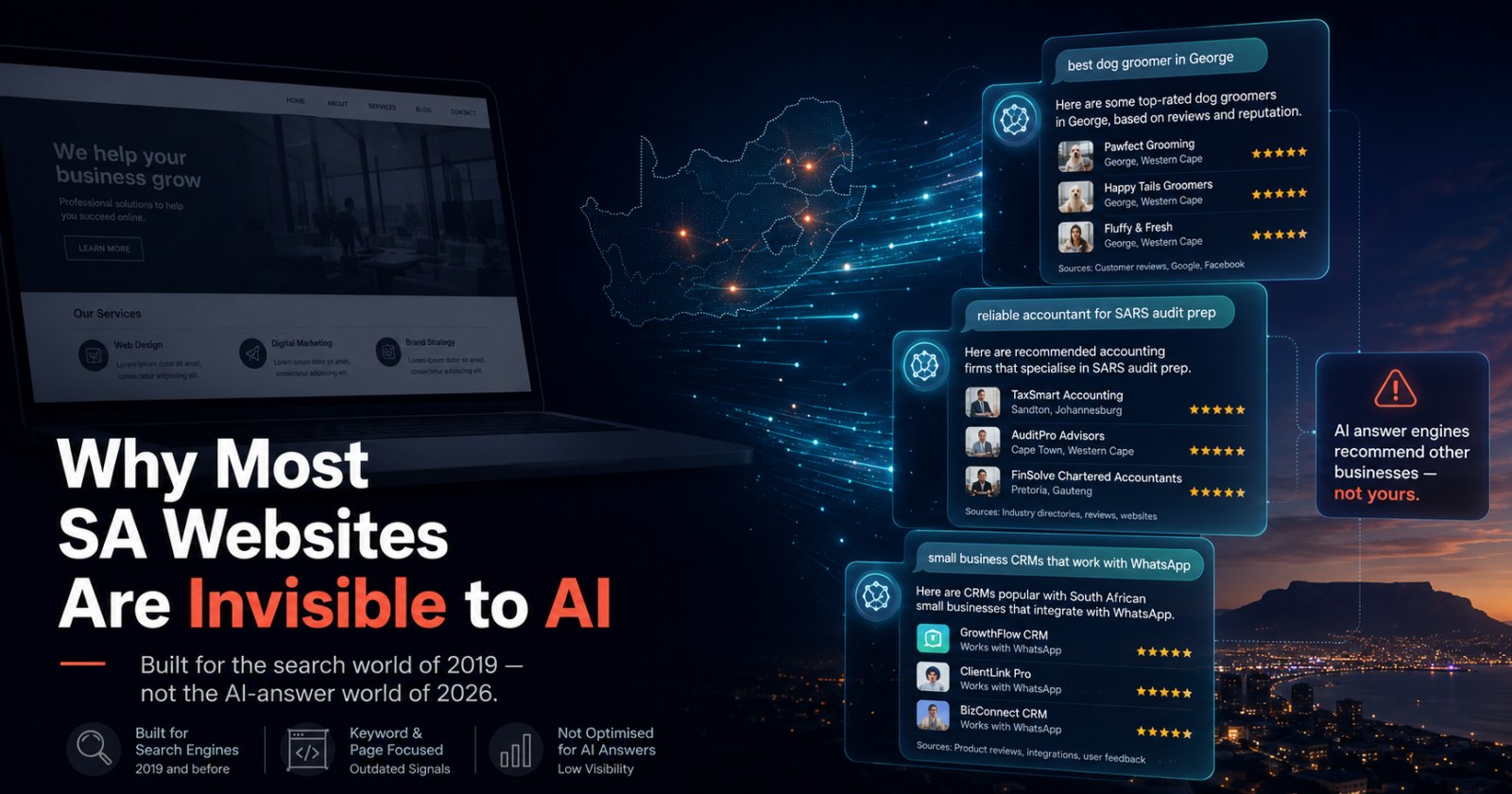
You can rank #1 on Google and still not exist to ChatGPT.
In 2026, your customers don't all search Google anymore. They ask ChatGPT for "the best dog groomer in George." They ask Claude to recommend "a reliable accountant for SARS audit prep." They ask Perplexity for "small business CRMs that work with WhatsApp." And the AI quietly recommends three businesses — none of which are yours.
This isn't a near-future scenario. It's the default behaviour right now. And most websites — yours likely included — are built for the search world of 2019, not the AI-answer world we actually live in.
This post explains why most SA websites are invisible to AI engines, the surface-level signals you can check yourself, and where the work gets technical enough that you probably want help.
The shift everyone's noticed but nobody's acted on
Traditional SEO is a 25-year-old discipline. The rules are well-understood: keywords, backlinks, page speed, content quality. Most agencies in South Africa know enough to get you to the first page of Google for terms you care about.
But here's the thing: Google itself is no longer the destination most searchers reach. Google's AI Overviews now sit above the traditional 10 blue links. ChatGPT has 600+ million weekly users asking it questions Google used to answer. Perplexity built a $9 billion business out of "ask, get an answer with citations" — no scrolling through pages.
For your business, the implication is brutal:
- Being on page one of Google is no longer enough. If the AI answer above the page-one results doesn't mention you, most of your traffic was filtered out before they ever saw your link.
- AI engines rank by a different rulebook. The signals they use to decide who to cite are related to traditional SEO but materially different. A site that ranks well in Google can be completely absent from AI answers — and vice versa.
- Most existing SA websites don't even register on AI rankings because the underlying infrastructure (schema, structured data, entity authority, AI-engine crawler permissions) was never built.
What AI engines actually care about
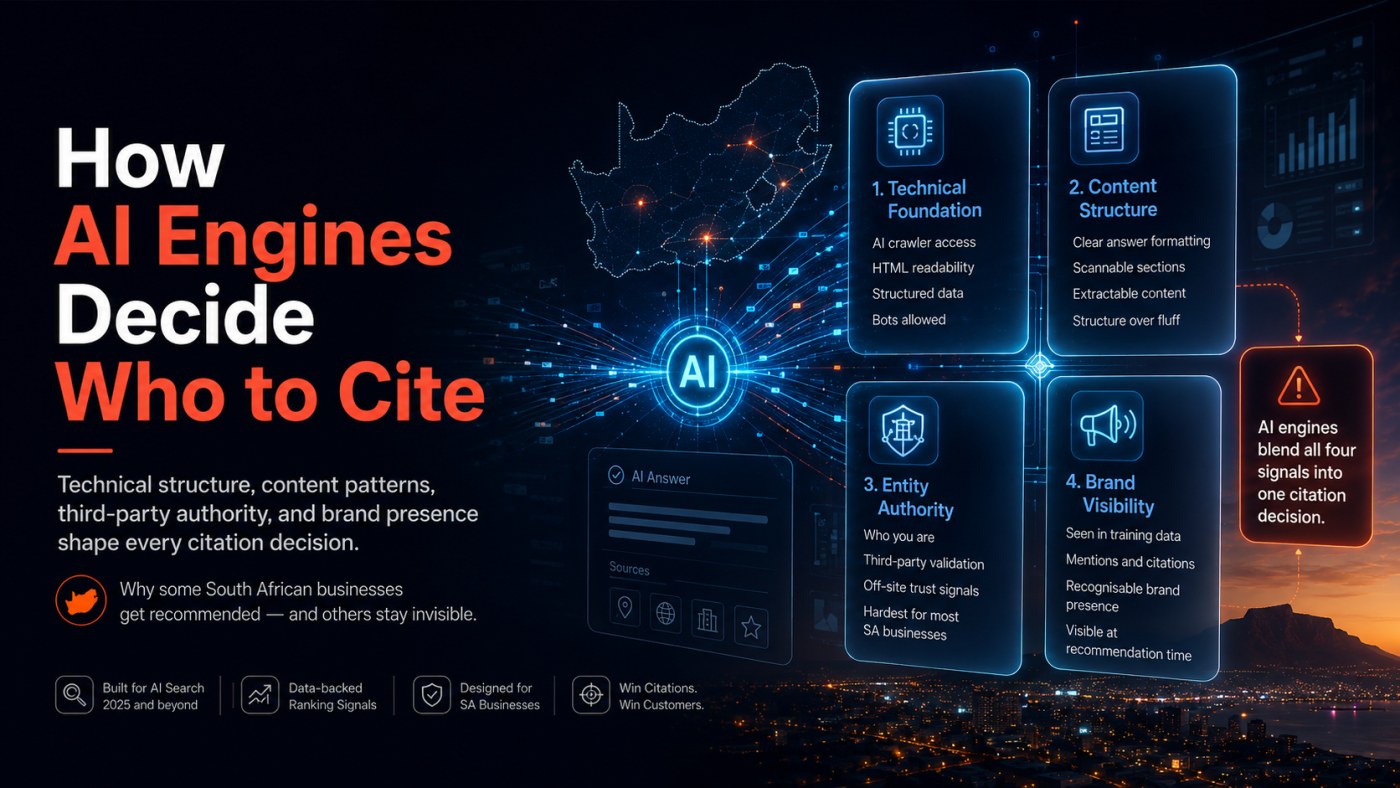
Without giving away the full methodology we use in our audits, AI search engines weigh four broad categories of signals when deciding which businesses to cite in an answer:
- Technical foundation. Whether the page is readable by AI crawlers in the first place, whether your site explicitly allows the bots used by major AI engines, whether key information sits in HTML or hides behind JavaScript, whether structured data describes your business in ways the engines understand.
- Content structure. Whether your content is shaped in ways AI engines can extract a clean answer from. Long unstructured paragraphs are great for human readers — and almost useless for an AI looking for a citable answer. The structure matters more than the prose.
- Entity authority. Whether AI engines can confidently identify who you are — not just what your site says about you, but what other authoritative sources say about you. This is where most SA businesses fail hardest, because the signals AI engines look for here are largely off-site and slow to accumulate.
- Brand visibility. Whether the engines have actually seen your brand mentioned, cited, and discussed in the data they were trained on. A brand that's invisible to the training data is invisible at recommendation time.
Each of these breaks down into dozens of specific, measurable signals. Some are quick to fix; some take months of strategic content + outreach work to move. Knowing which is which is the difference between three weeks of work and a year of guessing.
A self-check anyone can do in 10 minutes
You don't need a full audit to get a directional sense of whether your site has the basics right. Three things you can check yourself, no tools required:
1. The "does it know you?" test
Open ChatGPT. Open Claude. Open Perplexity. Ask each one: "What is [Your Business Name]?"
- If all three give you an accurate, confident answer: your brand signal is strong. You're already in their training data.
- If they give you a vague or wrong answer: the engines have heard of something with your name but don't have clean enough signal to be sure who you are.
- If they say "I don't have information about that": you're invisible. This is the most common outcome for SA SMBs, and it's fixable, but it takes intentional work.
2. The robots.txt check
Go to https://yoursite.com/robots.txt. Look for explicit "Allow" lines for the AI engines:
GPTBot(OpenAI / ChatGPT)ClaudeBot(Anthropic)PerplexityBot(Perplexity)Google-Extended(Google's AI training crawler — separate from regular Googlebot)
If your robots.txt doesn't mention any of these — or if you've actively blocked them assuming they're "bad bots" — your site is missing a basic permission gate that lets AI engines learn about you in the first place. Roughly 70% of SA websites we've audited have this wrong.
3. The "view source" smoke test
Right-click your homepage, view page source, search for application/ld+json. If you find a block of structured data identifying your business — what you do, where you're located, what services you offer — that's a positive signal. If you find nothing, AI engines have to guess from page text alone, and they often guess wrong.
Where it gets technical (and why you probably want help)
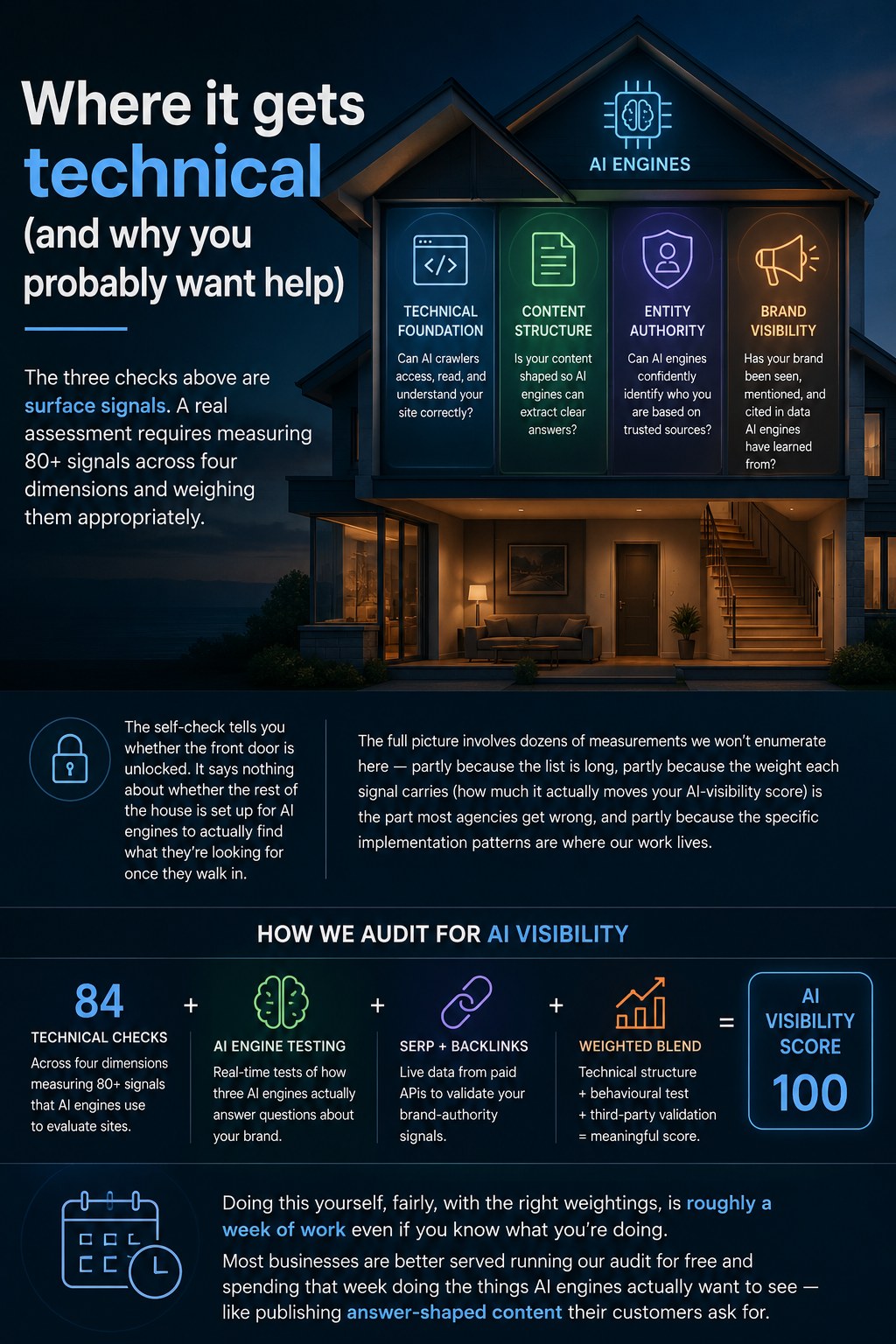
The self-check tells you whether the front door is unlocked. It says nothing about whether the rest of the house is set up for AI engines to actually find what they're looking for once they walk in.
The full picture involves dozens of measurements we won't enumerate here — partly because the list is long, partly because the weight each signal carries (how much it actually moves your AI-visibility score) is the part most agencies get wrong, and partly because the specific implementation patterns are where our work lives.
What we'll say is this: when we audit a site, we run 84 checks across four dimensions, blend the technical signal with a real-time test of how three different AI engines actually answer questions about the brand, and look at SERP + backlinks data pulled from paid APIs to validate the brand-authority signal. That blend — technical structure + behavioural test + third-party validation — is what makes the score meaningful instead of just a checklist.
Doing this yourself, fairly, with the right weightings, is roughly a week of work even if you know what you're doing. Most businesses are better served running our audit for free and spending that week doing the things AI engines actually want to see — like publishing answer-shaped content their customers ask for.
What good looks like
An AI-ready website has these characteristics by default:
- Every page renders meaningful content in HTML — not behind JavaScript that AI crawlers may or may not execute.
- Structured data identifies the organisation, its services, key locations, FAQ content, articles, products — in formats AI engines parse natively.
- Content is organised into clearly extractable answers. Question-shaped headings, definition-rich opening sentences, short-form sections AI can pull as snippets.
- Brand and entity signals are reinforced across the site itself and (importantly) across third-party sources AI engines trust.
- Critical crawler permissions (GPTBot, ClaudeBot, PerplexityBot, Google-Extended) are explicitly allowed.
- Performance is fast enough that AI crawlers don't time out — they have shorter patience than Google does.
That's the surface. The actual work of getting a site there — and keeping it there — is what we do.
Two ways to find out where you stand
If you've read this far, you probably want to know what's actually going on with your own site. We've built two ways to figure that out:
Whichever path you take, the first step is the same: find out where you actually stand. Most businesses we audit are surprised — both ways. Sites with poor traditional SEO sometimes score well on AI-visibility because their content happens to be shaped right. Sites with strong Google rankings often score poorly because they were built for a different era.
Either way, you don't get to opt out of AI search just because you weren't paying attention. Your customers already are.