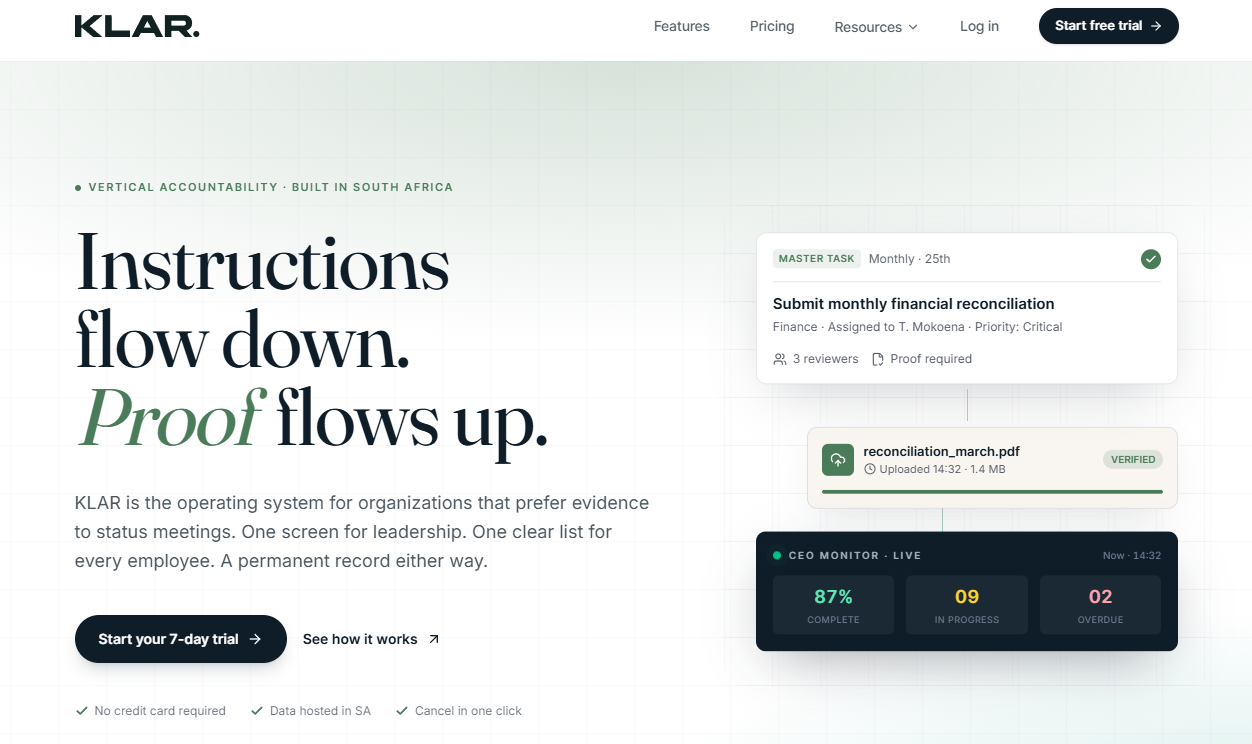
Instructions flow down. Proof flows up.
Klar is accountability software from EzeMind AI, built in George, South Africa, that replaces verbal status meetings, WhatsApp threads, and scattered spreadsheets with a single system of recurring tasks, mandatory proof of completion, and a real-time leadership dashboard — purpose-built for organisations that need documented evidence of recurring operational and compliance work.
Klar is not a project management tool. It is built for the recurring, cyclical work that runs a business month after month — compliance checks, department sign-offs, end-of-month closeouts, board packs, safety inspections, regulatory filings. Klar helps finance teams, compliance leads, and CEOs track the recurring work that must be done, proved, and reviewed every cycle.
Klar is developed and supported by EzeMind AI in George, Western Cape, and is available to any South African organisation that needs proof instead of promises.
The problem Klar is designed to solve
Most hierarchical organisations suffer from the same three failures. Managers ask subordinates for updates. Subordinates report verbally or in a WhatsApp thread. The conversation ends — and nothing permanent remains.
Klar addresses three specific failures:
- No visibility. Leaders rely on status meetings and word-of-mouth to understand what is happening across departments. There is no single source of truth.
- No proof. Tasks are marked "done" without documentation. When an auditor, board member, or SARS inspector asks for evidence, the evidence does not exist in a single, searchable place.
- No structure. Accountability is scattered across spreadsheets, WhatsApp groups, email threads, and someone's notebook. Institutional memory lives in people, not systems — and leaves when they do.
Example: a mid-sized SA manufacturing business runs monthly safety inspections. The safety officer completes each one, then updates the MD in a WhatsApp voice note. Six months later the DoL asks for inspection evidence. The business knows the inspections happened — but the evidence lives across six WhatsApp chats, two spreadsheets, and one former employee's cellphone. Klar is designed to remove exactly this failure mode.
How Klar works — three pillars
Klar's architecture is built around three concepts, all visible on the live product: Master, Plan, and Monitor. The same example threads through each.
1. Master: set recurring expectations once
The Master layer is where leaders define what the business actually does every week, month, quarter, and year. Each recurring task is assigned a department, a priority, a cadence, and a responsible role.
Unlike project management tools where tasks are one-off, Klar's master list persists beyond staff changes. When a senior accountant leaves, the tasks she was accountable for are still in the system waiting for her replacement.
Worked example: "Monthly bank reconciliation" is entered once in Master — assigned to the Finance department, due by the 5th of every month, responsible role: Senior Accountant, proof type required: signed reconciliation PDF.
2. Plan — plans that build themselves
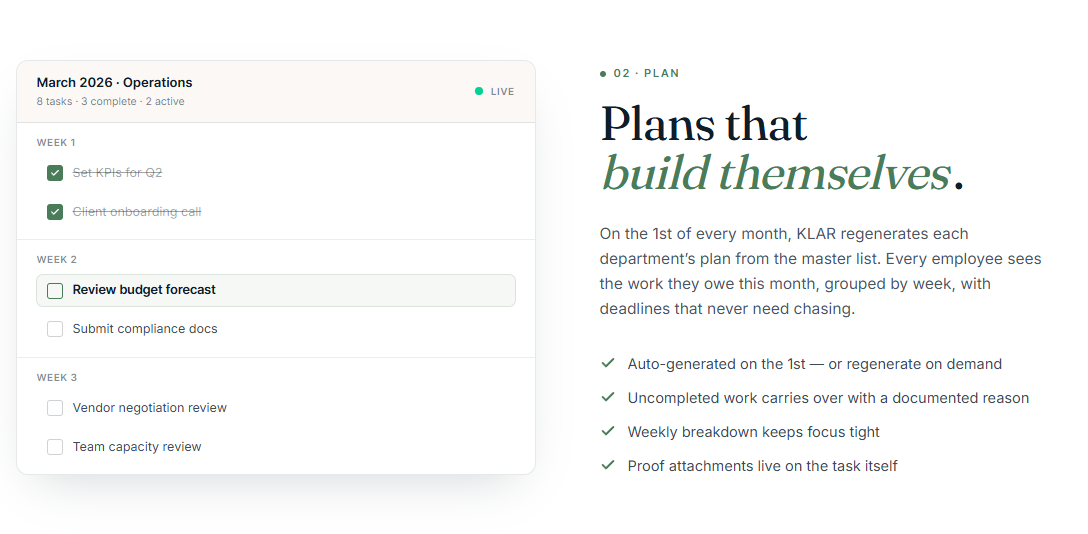
Every month, Klar's Plan layer automatically rolls the master list into a fresh monthly plan. No-one rebuilds a checklist. No-one forgets a compliance filing because it was only remembered by one person.
On the 1st of every month, Klar regenerates each department's plan from the master list. Every employee sees the work they owe this month, grouped by week, with deadlines that never need chasing. Department heads see their team's tasks. Team members see their own. The CEO sees everything.
- Auto-generated on the 1st — or regenerate on demand
- Uncompleted work carries over with a documented reason
- Weekly breakdown keeps focus tight
- Proof attachments live on the task itself
Worked example continued: On the 1st of the month, the "Monthly bank reconciliation" task appears automatically on the Finance department's plan with the 5th-of-the-month due date. The senior accountant sees it. Her department head sees it. The MD sees it on the dashboard.
3. Monitor — the screen every CEO actually opens
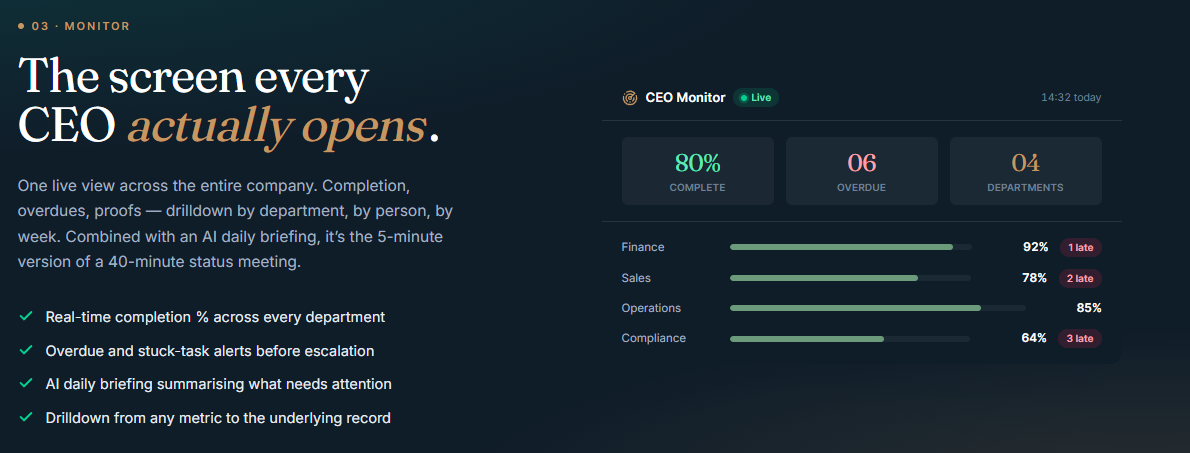
The Monitor layer is where Klar most clearly differs from other tools. Every task requires proof of completion before it closes — a document, a photo, a signed form, a screenshot, whatever the organisation's review process requires.
One live view across the entire company. Completion, overdues, proofs — drilldown by department, by person, by week. Combined with an AI daily briefing, it's the 5-minute version of a 40-minute status meeting.
- Real-time completion % across every department
- Overdue and stuck-task alerts before escalation
- AI daily briefing summarising what needs attention
- Drilldown from any metric to the underlying record
Worked example completed: On the 4th, the senior accountant uploads a signed bank-reconciliation PDF. Her manager reviews the proof and marks it approved. The task closes. The MD's dashboard now shows Finance is 100% on track for the month. No meeting required. When the annual audit arrives, the complete evidence chain — task, due date, responsible person, proof file, reviewer, timestamps — is already in one place, exportable in seconds.
Why Klar is different from project management tools
Most organisations already use Asana, Monday.com, Trello, or Notion. They use them for projects — one-off initiatives with start dates, end dates, and discrete deliverables.
Klar operates on the opposite axis. Those tools can be adapted for recurring work, but they are not purpose-built for proof-heavy accountability cycles:
| Project management tools | Klar | |
|---|---|---|
| Designed for | One-off projects with discrete deliverables | Recurring, cyclical work that repeats every month, quarter, year |
| Tasks | End when the project ships | Persist across staff turnover, months, and years |
| Completion | Check a box | Upload proof artefact — required, not optional |
| Reporting | Status reports leaders still have to read | Real-time dashboard; no report writing required |
| Best for | Product launches, client deliverables, campaigns | Compliance cycles, monthly closeouts, audit prep, SARS reporting support |
| Weakness | Adapts poorly to recurring monthly cycles | Not designed for one-off project work |
| Typical buyer | Product managers, team leads | CEOs, MDs, compliance officers, accountants |
The tools do not compete directly. A well-run organisation typically uses both — project management for initiatives, Klar for the recurring operational work that keeps the lights on and the auditors satisfied.
Who Klar is built for
Klar's design choices make the most sense for organisations with recurring, proof-heavy accountability cycles. In order of natural fit:
- CEOs and MDs of multi-department SMEs — where leadership needs visibility across finance, operations, compliance, HR, and production without sitting in a daily status meeting
- Finance and compliance teams — handling monthly reconciliations, quarterly filings, annual audits, and recurring policy attestations that require documented evidence trails
- Family businesses formalising operations — where the organisation has outgrown "dad remembers everything" and needs repeatable, institution-level processes
- Companies rebuilding after compliance incidents — where the board demands evidence that governance is now real, documented, and reviewable
- Multi-branch or multi-department operations — where accountability is currently scattered across silos and leadership cannot easily see end-to-end status
Klar is not designed for small creative teams doing one-off client projects, freelancers running single-person operations, or organisations that do not have recurring compliance or operational cycles.
SARS audit readiness and data governance
South African organisations face a specific operational risk: audit trail completeness. When SARS, an internal auditor, or a board committee asks for evidence that a control was executed, the organisation needs to produce it quickly — and in a form that is trustworthy.
Klar supports this by design:
- Every task completion includes a proof artefact — document, photo, signed form, or screenshot — attached by the person who completed it
- Every action is logged with a permanent timestamp and responsible user
- Audit trails can be exported for any time period — monthly, quarterly, annual, or arbitrary ranges — for board packs or auditor review
- Data is hosted on South African infrastructure with encryption at rest and role-scoped access controls
- User access is scoped by role, so employees only see the work that concerns them
For organisations preparing for an internal control review, POPIA readiness workstream, or SARS audit support process, Klar helps maintain the documented evidence and audit trails that support those processes. The POPIA compliance framework and specific regulatory frameworks should always be reviewed with qualified legal and audit advisors — Klar provides the operational infrastructure; it does not replace professional compliance counsel.
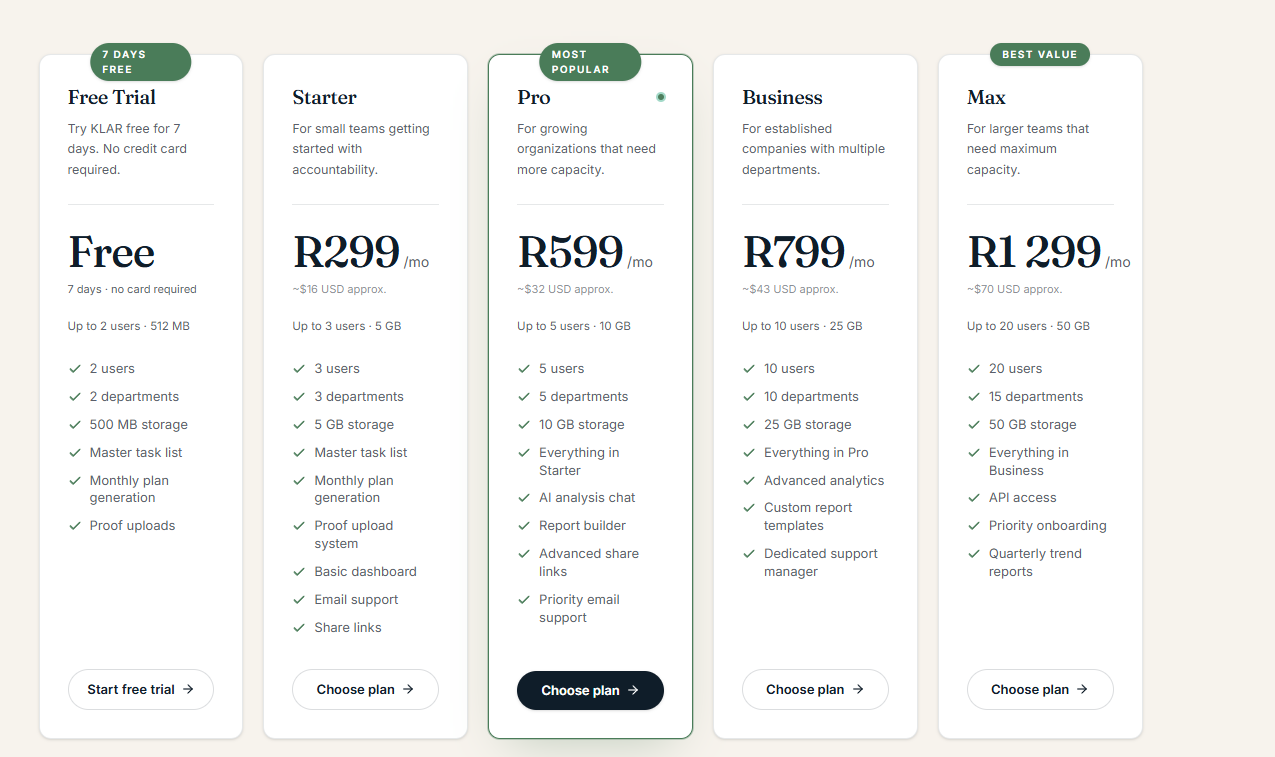
Pricing
Frequently asked questions about Klar
Can Klar replace spreadsheets and WhatsApp checklists?
Yes — that is the primary use case. Klar is specifically designed to replace the ad-hoc combination of Excel trackers, WhatsApp group updates, and email threads that most SA organisations still use for recurring operational work. Where spreadsheets and WhatsApp have no enforcement, audit trail, or proof requirement, Klar has all three by default.
What evidence can users upload as proof of completion?
Any standard file format that demonstrates the task was done — PDFs, signed forms, photographs, screenshots, spreadsheet exports, or scanned documents. The exact proof type required for each task is defined in the Master layer, so completion is consistent across departments and over time.
Does Klar support multi-branch or multi-department organisations?
Yes. Klar is explicitly designed for hierarchical, multi-department operations. Tasks can be scoped by department, and role-scoped access means branch managers see their own operations while head-office leadership gets an aggregated dashboard view across everything.
Can management export reports for board or audit review?
Yes. Audit trails can be exported for any time period. The Pro, Business, and Max tiers add custom report templates and advanced analytics; Enterprise adds bespoke report configurations. Exports are designed to be suitable as supporting evidence for internal control reviews and external audits.
Do I need to stop using Monday.com or Asana to use Klar?
No. Klar and project management tools solve different problems and most organisations use both. Keep Monday.com or Asana for one-off projects with discrete deliverables. Use Klar for the recurring, evidence-required operational work — compliance cycles, reconciliations, audits, sign-offs. The tools coexist comfortably.
Is Klar POPIA and SARS compliant?
Klar is built to support POPIA readiness workstreams and SARS audit preparation, not to provide formal compliance certification. It does this by hosting data on South African infrastructure, enforcing role-scoped access, capturing timestamped audit trails, and enabling proof-backed task completion. Specific regulatory frameworks should always be reviewed with qualified legal and audit advisors.
How long does it take to set up Klar?
Most organisations are operational the same day the master task list is defined. The 7-day free trial is long enough for a small team to stand up its first month's plan, complete tasks with proof uploads, and see the dashboard populate. Priority onboarding is included in the Max tier and available as a premium service in Enterprise.
Where is my data stored?
On South African infrastructure, with encryption at rest and role-scoped access controls. Klar is built and supported in George, Western Cape, by EzeMind AI. Enterprise customers may request on-premise deployment.
Who builds and supports Klar?
Klar is developed and maintained by EzeMind AI, a South African technology company based in George, Western Cape. EzeMind AI also develops AVA Healthcare (for care facilities), EzeFlow (payment request management), EzeHealth (digital care management), and custom AI and software solutions for businesses across South Africa and internationally.