

Every business runs AI now. Most are quietly on the wrong side of POPIA and don't know it.
Your marketing manager runs your customer list through ChatGPT to write personalised follow-ups. Your sales team uses Otter to transcribe client meetings. HR drops CVs into an AI screening tool that scores candidates. Finance uploads invoices to an OCR tool that auto-extracts supplier details.
Every one of those workflows is a POPIA event. Most South African businesses doing this in 2026 either don't realise it, or assume "everyone's doing it, so it must be fine." Neither is true. The Information Regulator started actively enforcing POPIA from July 2021, and the fines and reputational risk are real — up to R10 million, or 10 years' imprisonment for serious offences.
This post is a practical orientation, not legal advice. The goal: help you spot where AI use intersects POPIA, walk through a decision tree for the most common case (when does AI processing need explicit consent?), and flag the trap that catches almost every SA SME using third-party AI APIs.
The 90-second POPIA refresher (for the AI-tools context)
POPIA — the Protection of Personal Information Act, 2013 — governs how every business in South Africa handles "personal information" (anything that identifies a natural or juristic person). The Act sets eight conditions for lawful processing:
- Accountability — you're responsible for what you do with the data, end of story.
- Processing limitation — only collect what you actually need, with a lawful basis.
- Purpose specification — you must know why you're collecting it before you collect it.
- Further processing limitation — you can't repurpose data outside the original specified purpose without a new basis.
- Information quality — keep it accurate and up to date.
- Openness — tell the data subject what you're doing and have a Promotion of Access to Information manual.
- Security safeguards — reasonable measures to protect what you hold.
- Data subject participation — give people access to their data, the right to correct it, and the right to delete it.
Most SMEs are vaguely aware these exist. The AI tools change is in how condition 2, 3, 4, 6, and 7 interact when you start sending data to systems you don't control.
Why AI tools complicate POPIA (three specific ways)
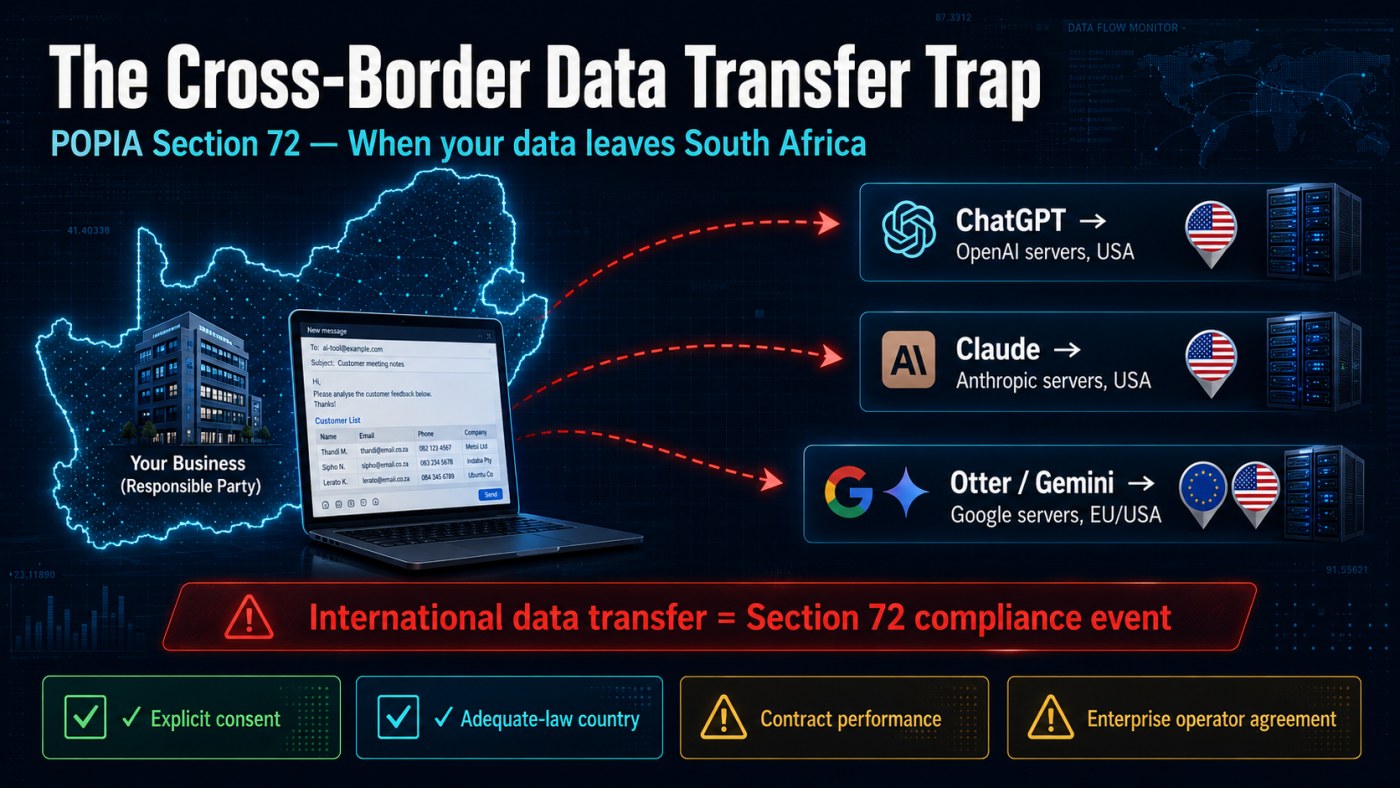
AI tools introduce three new wrinkles that traditional software doesn't have:
1. The cross-border data transfer trap
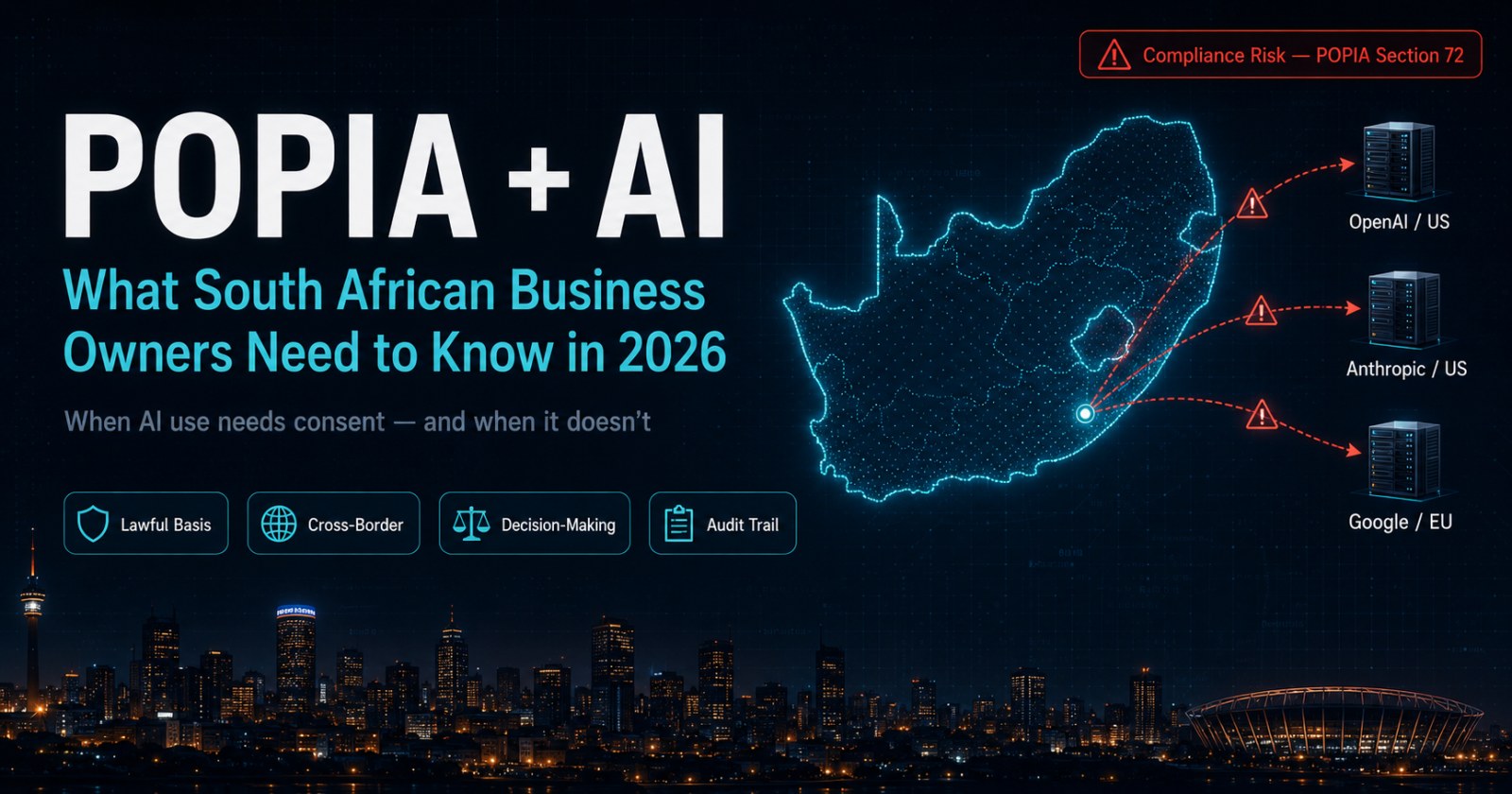
Most popular AI services — ChatGPT, Claude, Gemini, Otter, Perplexity, every consumer-grade AI tool — process data on servers outside South Africa. POPIA's Section 72 restricts cross-border transfer of personal information unless one of a small set of conditions is met (the recipient is subject to similar laws, the data subject consents, the transfer is necessary for contract performance, etc.).
Pasting a customer list into ChatGPT to draft follow-up emails? That's an international data transfer to OpenAI's US infrastructure. Without a documented lawful basis under Section 72, it's a POPIA breach. Most businesses we talk to have never thought about it this way.
2. Operator agreements that don't exist
Under POPIA, when you process personal information through a third party (an "operator"), you need a written contract specifying how that operator handles the data — security measures, subprocessor disclosure, breach notification, data deletion on contract end. Consumer subscriptions to AI tools (the $20/month ChatGPT Plus, the personal Otter account, etc.) don't include this. The operator agreement only exists on enterprise tiers, and even then needs review.
If you're using consumer-tier AI to process customer data, you almost certainly don't have a compliant operator arrangement.
3. Automated decision-making rights
POPIA gives data subjects the right not to be subject to a decision based solely on automated processing that has legal or similarly significant effects on them (Section 71). If your AI tool decides who gets a quote, who gets shortlisted for a job, what credit terms a customer gets — and there's no meaningful human review — the affected person has the right to object and demand a human-reviewed decision. Most SA businesses using AI screening don't have this process in place.
Decision tree: does this AI use need explicit consent?
The single most common question SA business owners ask us is: "Do I need to ask every customer for consent before I use AI on their data?"
The honest answer: usually no, but you need a different lawful basis instead. POPIA recognises six lawful bases for processing personal information — consent is just one of them. The others include legitimate interest, contract performance, legal obligation, and a few more.
Here's the decision tree we walk clients through for routine AI use cases:
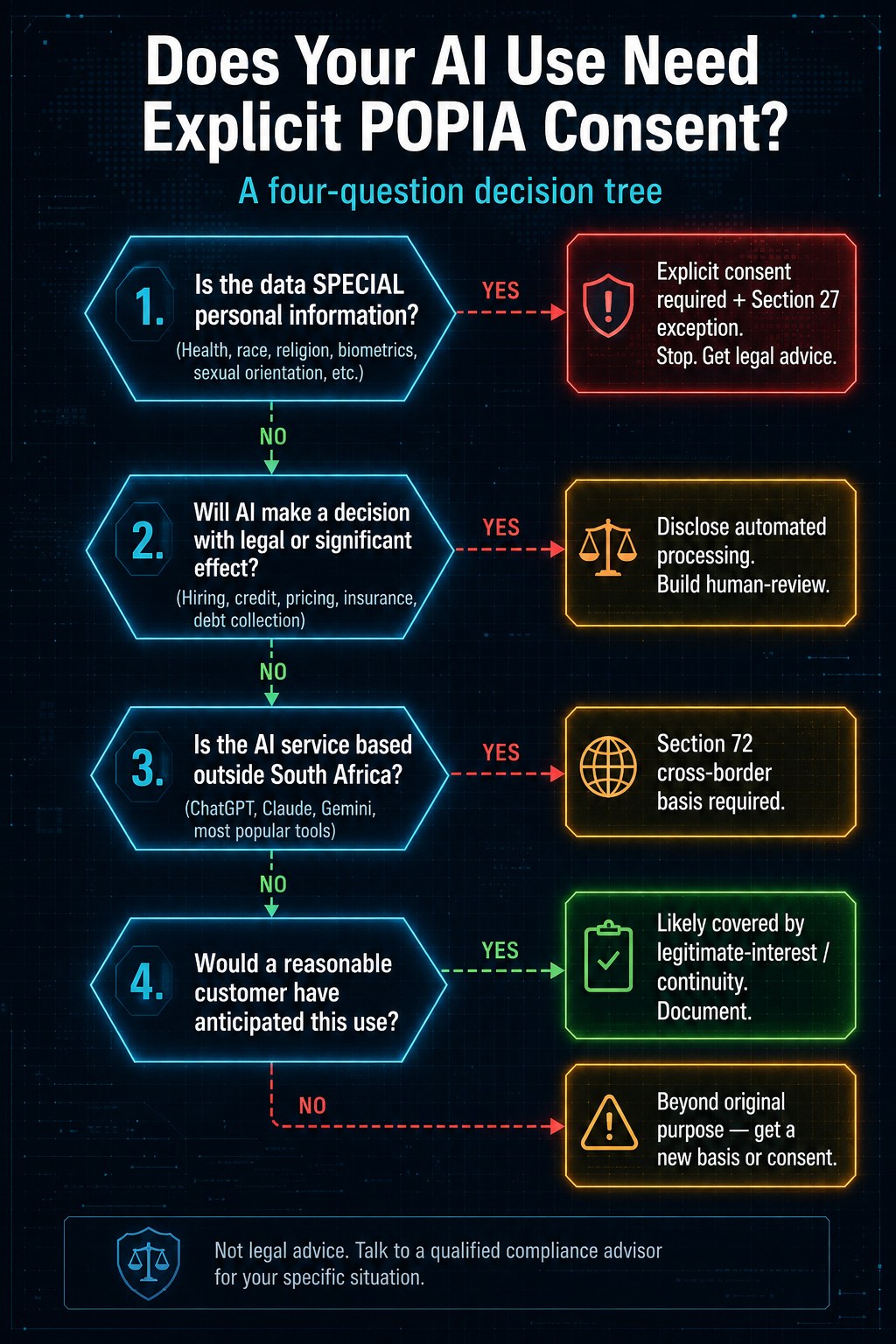
- Question 1: Is the data "special personal information"? (religion, race, health, biometrics, sexual orientation, criminal behaviour, trade union membership, political affiliations). If YES, you almost always need explicit consent and a specific Section 27 exception. Stop, get advice, document everything.
- Question 2: Will the AI make a decision with legal or similarly significant effect on the person? Credit decisions, hiring decisions, insurance pricing, debt collection scoring. If YES, you must build in meaningful human review and disclose the automated processing.
- Question 3: Is the AI service based outside South Africa? If YES, you need a Section 72 cross-border-transfer lawful basis documented — typically either explicit consent OR a determination that the recipient operates under "adequate" data-protection law (which most US providers do not formally satisfy, though enterprise contracts can bridge the gap).
- Question 4: Could a reasonable customer have anticipated this use when they gave you their data? If they signed up for marketing emails and you use AI to write better marketing emails, that's reasonable continuity. If they shared a service-request and you feed it into an AI that determines their pricing tier, that's a stretch beyond the original purpose.
A "no" to question 1 and 2, with a documented basis at question 3 and a "reasonable continuity" answer at question 4, is the path most legitimate AI marketing/operational use takes. A "yes" to 1 or 2 changes the conversation entirely.
What "good" looks like (without giving you a copy-paste playbook)
Businesses that handle this well — the ones that won't get hammered if the Information Regulator audits them — have a few things in common:
- An inventory of every AI tool in use, the data it processes, where it processes it, and what lawful basis applies. Most SMEs can't produce this on demand. The ones that can are the ones who pass scrutiny.
- Privacy notices that mention AI specifically — not the generic 2019-era "we may use third-party providers" wording, but explicit "we use AI tools to [purpose], and you have the right to [object/access/delete]." Plain language. Not buried.
- An audit trail of every AI-processed event — what data went in, when, who initiated it, what the AI returned, and (for automated decisions) what the human-review step was. This is non-negotiable if you face a regulatory query.
- Documented operator agreements with every AI vendor that touches personal information — covering security, breach notification, and data deletion. Free-tier AI use for customer data fails this test.
- A human-review process for any AI-assisted decision with significant impact, with documented criteria for what triggers human review.
None of this is exotic — it's just diligent operational hygiene. The catch is that it requires a system that captures and stores the trail, not a spreadsheet that nobody updates.
Where Klar fits in this picture
Klar is our accountability platform — designed from day one for the kind of audit-trail-heavy, evidence-required work POPIA assumes you're doing. Every recurring task (including the recurring POPIA tasks: privacy-notice reviews, operator-agreement audits, AI tool inventories, breach-response drills) lives in the Master layer. Every completion produces a timestamped proof artefact — the document, the screenshot, the signed-off review. The Monitor dashboard gives the Information Officer one place to see "is this organisation actually doing the compliance work it claims to."
That doesn't make you POPIA-compliant on its own (your lawyer makes you compliant). It makes you auditable — which is the difference between "we promise we're compliant" and "here's the documented evidence we are."
For SA businesses where AI tools are now a standard part of operations, the gap between those two postures has become the single biggest compliance risk.
This article is general information about POPIA and AI use. It does not constitute legal advice. Specific compliance decisions should be reviewed with a qualified attorney or compliance professional familiar with the Protection of Personal Information Act, 2013, the Information Regulator's guidance notes, and your business's particular circumstances.